HEFEI, China, Oct. 21, 2026 /PRNewswire/ -- Sungrow, a globally leading PV inverter and energy storage system provider, announced that its latest PowerTitan 3.0 battery energy storage system (BESS) has successfully completed a large-scale fire test conducted in accordance with the latest applicable requirements of UL 9540A: 2026 and CSA/ANSI C800-2025, making it the industry's first stacked-cell BESS with an AC-block design to successfully complete such a test. From PowerTitan 1.0 to 3.0, all three generations passed the large-scale fire test on the first attempt.
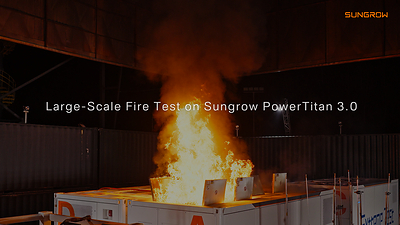
Conducted by UL Solutions, witnessed by Fire Risk Alliance (FRA), and observed by Jensen Hughes (JH), the test evaluated the system's ability to contain a severe thermal runaway event and prevent it from propagating to adjacent BESS containers and the Medium-Voltage Substation.
Tested Under Demanding Real-World Installation Conditions
The test setup replicated the block-level layout of a real-world utility-scale BESS installation, including 28.56 MWh of fully liquid-cooled PowerTitan 3.0 BESS and a 7.4 MW Medium-Voltage Substation (MVS). PowerTitan 3.0 features high-energy-density stacked cells and an integrated AC block architecture, combining the battery system and DC/AC Power Converter Unit within a single 20-foot container.
To further challenge the system's safety design, the BESS was at 100% state of charge. The initiating container and the adjacent container were installed back-to-back closely. The MVS was also included in the test configuration. All active fire suppression systems and thermal management system were disabled, and rooftop pressure-relief panels of the initiating container were also fully opened to maximize ventilation and oxygen availability. The test focused on the system's inherent ability to contain thermal runaway.
All smoke and fire effluent generated during the event were collected and routed through a dedicated purification system. The collected gases were fully treated, with no untreated smoke released directly into the environment.
Thermal Runaway Did Not Propagate
The test successfully demonstrated that thermal runaway did not propagate from the initiating BESS container to any adjacent containers or the MVS.
The test continued for 7.5 hours under uninterrupted monitoring. The peak internal temperature in the initiating container, identified as Container A, reached 1259.8°C, while the highest cell temperature in the adjacent containers well remained below the threshold for thermal runaway under UL 9540A: 2026.
Despite the intensity and duration of the fire, Container A remained structurally intact. Adjacent Containers B, C, D and E also remained structurally intact, with no deformation. Even after the fire test, the container remained structurally intact and could be lifted as a complete unit.
Under full-charge, close-spacing and maximum-ventilation conditions, the PowerTitan 3.0 contained the thermal event within the initiating container and prevented it from escalating into a multi-container event. The results demonstrate stable, reliable and controllable system performance under extreme conditions and mark a key step in validating the safety of higher-energy BESS platforms.
Three Generations. All Successfully Tested. Simulation Meets Reality.
From PowerTitan 1.0 and 2.0 to PowerTitan 3.0, all three generations have completed their large-scale fire tests on the first attempt, enabling Sungrow to build a comprehensive database of thermal runaway and fire behavior. Before the physical test, PowerTitan 3.0 underwent simulation-based assessments across hundreds of application scenarios and operating conditions using Sungrow's simulation platform, the world's largest of its kind. The simulated fire intensity and development trends closely matched those observed during the physical test, validating the model's ability to predict fire behavior under extreme conditions.
"This test was about verifying our safety design under real-world extreme conditions," said Roger Li, General Manager of the Utility-Scale Product Line, Sungrow Energy Storage Business Unit. "Safety must be engineered into the product from the beginning. Simulation helps predict how the system will respond, while large-scale fire testing puts those predictions to the test. Energy storage safety is about far more than cell safety alone. It is the result of multiple factors working together, including cell performance, system integration, thermal management, structural protection, engineering design, and more."
Benjamin Liu, Engineering Manager at UL Solutions, commented: "Sungrow started with safety by design, used pre-test assessments to predict fire behavior, and then validated those predictions through a large-scale fire test. The test result showed that the design was able to contain the fire and prevent propagation, helping significantly reduce the potential scale of loss."
By bringing together safety-by-design engineering, predictive simulation and large-scale physical testing, Sungrow is building a robust, evidence-based approach to BESS safety. For project owners, investors, insurers and emergency responders, this provides a stronger technical basis for assessing fire risks, planning emergency responses and protecting critical assets throughout a project's lifecycle.
 View original content to download multimedia:https://www.prnewswire.co.uk/news-releases/three-generations-all-first-time-passes-powertitan-3-0-validates-system-level-safety-under-extreme-large-scale-fire-test-302915315.html

Die Bildung einer neuen Landesregierung in Berlin bleibt vorerst ungewiss. Linke, Grüne und SPD konnten sich zweieinhalb Wochen nach der Wahl zum Abgeordnetenhaus weiterhin nicht auf eine gemeinsame Linie im Umgang mit Antisemitismus verständigen. Nach dem dritten sogenannten Vorgespräch verließ die Spitze der drei Parteien am Mittwochnachmittag den Tagungsort ohne öffentliche Stellungnahme. Nach Informationen der Deutschen Presse-Agentur gilt eine Einigung in der Frage als zentrale Voraussetzung, um in formelle Sondierungsgespräche über eine mögliche Regierung unter Führung der Linken einzusteigen.
Bereits für Donnerstag ist ein weiteres Treffen angesetzt. Ziel ist es, in dem seit geraumer Zeit in Berlin heftig diskutierten Themenkomplex voranzukommen. Vor allem Teile der Berliner Linken stehen seit längerem wegen Positionen zu Israel, Palästina und zum Thema Antisemitismus in der Kritik. Dabei geht es insbesondere um Äußerungen einzelner Parteimitglieder, die öffentlich als antisemitisch eingestuft oder entsprechend kritisiert wurden. Ohne eine belastbare Verständigung auf gemeinsame Grundsätze wollen SPD und Grüne nach eigener Darstellung den nächsten Schritt hin zu einem möglichen Regierungsbündnis nicht gehen.
Zusätzliche Brisanz erhielt die Debatte durch eine Wahlparty der Neuköllner Linken am 20. September. Dort waren nach dpa-Informationen sowohl ein Oberhaupt eines arabischstämmigen und zum Teil kriminellen Clans als auch ein umstrittener propalästinensischer Aktivist anwesend. Letzterer soll der Volksfront für die Befreiung Palästinas (PFLP) nahestehen, die von der EU als Terrororganisation eingestuft wird. Der Vorfall hat bei den potenziellen Koalitionspartnern für erhebliche Irritationen gesorgt und den Druck auf die Linke erhöht, sich klarer zu Antisemitismus, Rassismus und organisierter Kriminalität zu positionieren.
SPD und Grüne verlangen vor Beginn offizieller Sondierungen eine verbindliche Verständigung zu diesen Themenfeldern. Sondierungen sind die Vorstufe zu formalen Koalitionsverhandlungen, in denen ein Regierungsprogramm und die Ressortzuschnitte ausgehandelt würden. Ohne Konsens über den künftigen Kurs im Kampf gegen Antisemitismus und im Umgang mit problematischen Milieus in der Stadt bleibt der Weg zu einem möglichen Rot-Grün-Roten Bündnis aber blockiert. Welche Alternativen zu einem solchen Bündnis am Ende realistisch wären, ist bislang offen; entscheidend bleibt vorerst, ob die drei Parteien in der strittigen Grundsatzfrage noch zu einer gemeinsamen Linie finden.


