VIENNA, May 21, 2026 /PRNewswire/ -- MGI Tech Co., Ltd. (MGI), a company committed to developing core tools and technologies that drive innovation in life sciences, presented its latest advancements in laboratory automation and integrated workflow solutions at SLAS 2026 in Vienna, Austria.
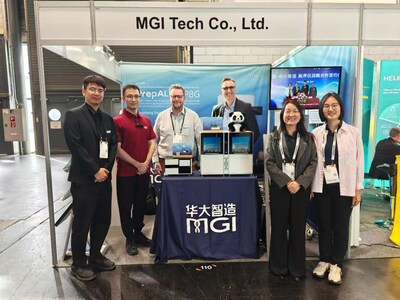
At this year's event, MGI Tech highlighted a portfolio of intelligent automation and multi-omics solutions designed to accelerate research efficiency, simplify complex workflows, and empower emerging applications in proteomics and integrated laboratory automation.
PrepALL-pP8G: Advancing Single-Cell Proteomics Automation
As an extension of the PrepALL platform, PrepALL-pP8G expands its application into the field of single-cell proteomics, primarily for sample pretreatment. A key attribute of the PrepALL platform is its inherent flexibility, allowing seamless integration with external devices to broaden its application scope,of which the PrepALL-pP8G is a prime example. Designed to highly automate and streamline complex proteomics workflows, the system combines thermal inkjet printing technology with high-precision ultra-low volume dispensing to enable a fully integrated workflow from single-cell sorting to proteomics sample preparation. The official European launch is expected in the second half of this year.
Featuring 640 independent parallel nozzles and advanced AI-assisted camera vision recognition, the PrepALL-pP8G enables ultra-high throughput processing of 384-well plates in just minutes while preserving cell viability and protein integrity through gentle, electrical-deflection-free sorting. The platform supports label-free, labeled, and conventional proteomics workflows, making it suitable for applications including tumor heterogeneity research, rare cell analysis, organoid and stem cell research, and multi-omics integration.
GenSIRO48: Enabling Next-Generation Clinical Automation
Making its first international debut, MGI Tech also presented the SIRO48, an advanced fully automated sample processing system designed to deliver a "Sample In, Report Out" solution that accelerates and simplifies complex sample processing workflows. The system integrates nucleic acid purification, fragmentation, end repair, adapter ligation, PCR amplification, and library purification & quality control in a single workflow.
Engineered to evolve from step-by-step manual operations to integrated full-process closed loop, multi-step manual intervention to full-process unattended execution, and low-throughput single-sample processing to high-throughput parallel processing of 48 samples, it is purpose-built for seamless integration into real-world clinical molecular diagnosis, public health prevention and control, and life science research scenarios. This system enables a transformative leap in sequencing library preparation—from "isolated manual operations" to "full-chain intelligent automation".
VisiOmics (PMIF-20RS): Boosting Spatial Proteomics Exploration in Translational Medicine
MGI Tech was also showcasing the PMIF VisiOmics (PMIF-20RS), a fully automated staining and imaging system making its European debut. It leverages multiplex immune fluorescence (mIF) technology to capture precise spatial protein expression data in tissue sections. Integrated with an AI-powered analysis platform for accurate cell segmentation, phenotyping, and spatial mapping, it provides a complete workflow solution for applications in tumor classification, prognosis, tumor microenvironment analysis, and translational research. The official European launch of VisiOmics is also expected to take place in the second half of this year.
Driving the Future of Intelligent Laboratory Automation
"SLAS provides an excellent platform to demonstrate how intelligent automation is transforming life science research and clinical laboratory operations," said a spokesperson for MGI Tech. "Our latest solutions are designed to help laboratories overcome workflow complexity, improve scalability, and accelerate scientific discovery across rapidly evolving research areas such as single-cell proteomics and organoid biology."
About MGI
MGI Tech Co., Ltd. (or its subsidiaries, together referred to as MGI) is committed to building core tools and technologies that drive innovation in life science. Our focus lies in research & development, manufacturing, and sales of instruments, reagents, and related products in the field of life science and biotechnology. We provide real-time, multi-omics, and a full spectrum of digital equipment and systems for precision medicine, agriculture, healthcare, and various other industries.
Founded in 2016, MGI has grown into a leader in life science, serving customers across six continents and establishing research, manufacturing, training, and after-sales service facilities globally. As one of the few companies capable of independently developing and mass-producing clinical-grade gene sequencers, MGI empowers global users with scalable sequencing capabilities ranging from Gb to Tb levels. MGI also stands out as one of the only providers of a full-stack product portfolio that spans three core segments: SEQ ALL (short- and long-read sequencing), GLI (Generative Lab Intelligence), and Multi-Omics. With unparalleled expertise, cutting-edge products, and a commitment to global impact, MGI continues to shape the trajectory of life sciences into the future.
To learn more, please visit MGI Tech, LinkedIn, X, Instagram, and YouTube.
Photo - https://mma.prnewswire.com/media/2985570/SLAS_Group_Photo.jpg
 View original content:https://www.prnewswire.co.uk/news-releases/mgi-tech-showcases-next-generation-laboratory-automation-and-multi-omics-solutions-at-slas-2026-302779389.html

In Thüringen ist ein großangelegtes Forschungsprojekt zur nächsten Generation der Nanostrukturierung gestartet. Wissenschaftlerinnen und Wissenschaftler der Technischen Universität Ilmenau, der Friedrich-Schiller-Universität Jena und des Fraunhofer-Instituts für Angewandte Optik und Feinmechanik (IOF) in Jena entwickeln gemeinsam eine Hochpräzisionsmaschine, die Nanostrukturen auf Flächen von bis zu einem Quadratmeter erzeugen und vermessen soll. Die geplante 3D-Nanolithographie- und Nanomessmaschine (3D-NLM) soll dabei eine Positionierungsgenauigkeit erreichen, die kleiner ist als ein Atom. Die Deutsche Forschungsgemeinschaft (DFG) unterstützt die erste Projektphase bis 2027 im Rahmen des Programms „Neue Geräte für die Forschung“ mit vier Millionen Euro.
Mit dem Vorhaben zielt das Konsortium auf eine Größenordnung, die bestehende Anlagen deutlich übertrifft. Bisher lassen sich hochpräzise Nanostrukturen auf photonischen Bauteilen nach Angaben der Projektbeteiligten nur bis zu einem Durchmesser von etwa 30 Zentimetern zuverlässig herstellen. Die neue Anlage soll Bearbeitungen und Messungen von Bauteilen mit Kantenlängen von bis zu einem Meter ermöglichen – und damit eine mehr als dreifache Vergrößerung der nutzbaren Fläche erschließen. Die Entwicklungsarbeiten an der Maschine sind angelaufen; das Gesamtprojekt ist in drei Phasen bis 2032 angelegt.
Nanostrukturen gelten seit rund zwei Jahrzehnten als Schlüsseltechnologie, weil sie Licht gezielt beeinflussen können, indem sie dessen Wellenlänge und Ausbreitung steuern. Solche Strukturen finden sich bereits heute in großflächigen Bauteilen, etwa in Displays moderner Fernsehgeräte, die auf Nanotechnologie basieren. Nach Einschätzung der Forscherinnen und Forscher reicht die Genauigkeit bestehender industrieller Lösungen jedoch nicht aus, um künftige Anforderungen in zentralen wissenschaftlichen und technologischen Anwendungsfeldern zu erfüllen.
Die in Thüringen entstehende 3D-NLM soll genau diese Lücke adressieren. Perspektivisch könnte die Maschine zur Fertigung und Charakterisierung elektronischer und photonischer Schaltkreise ebenso eingesetzt werden wie zur Herstellung von Hochleistungsoptiken für die Erdbeobachtung. Auch in der Energieforschung sehen die Projektpartner potenzielle Einsatzfelder. Durch die Kombination aus großflächiger Bearbeitung und atomnaher Präzision erhoffen sich die Beteiligten einen technologischen Sprung, der sowohl der Grundlagenforschung als auch der Entwicklung neuer Komponenten in der Optik- und Elektronikindustrie zugutekommen könnte.