SINGAPORE, Sept. 21, 2026 /PRNewswire/ -- Chinese travellers are gearing up for one of the busiest travel periods, as Trip.com Group's latest data reveals earlier departures and longer trips planned this Golden Week. By taking three days off this year, workers can extend their holiday into a 13-day break, combining their Golden Week and Mid-Autumn Festival holidays into one. Outbound departures are expected to spike as early as September 25th, with an average trip length of over nine days.

Earlier Departures and Longer Trips
With the Mid-Autumn Festival landing the Friday before the Golden Week holidays in October this year, Chinese travellers are shifting their vacations earlier to avoid the holiday rush. More than half of the outbound flight bookings made are for departures before the official holiday begins on October 1st, with daily departure volume peaks on September 25th and 30th.
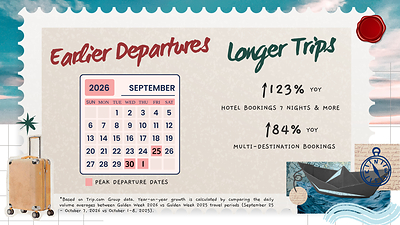
Chinese tourists are not just departing earlier, they are also making use of the extended break to take longer and further trips beyond the region. Bookings for hotel stays of seven nights and more are seeing a year-on-year (YoY) jump of 123%, and even faster growth is seen for bookings in major European cities like London and Paris. Similarly, long-haul flight bookings are set to see double-digit YoY growth, with demand concentrating among gateway cities in Europe, Australia and the United States.
One Trip, Multiple Destinations
As Chinese travellers venture further, multi-destination trips are experiencing a surge in demand. Bookings for multi-destination itineraries have risen by 84% YoY, reflecting a growing trend to maximise long-haul travel across multiple cities. Southeast Asia and Europe are some of the top destinations for multi-stop journeys, and popular combinations include Singapore - Bali (Southeast Asia), Hong Kong - Sydney, and Amsterdam - Milan (Europe)[1].

Rising Hotspots: Nature Escapes and Cultural Heritage Immersion
Mountain landscapes and coastal retreats are where Chinese audiences are headed to this Golden Week, with searches for "scenic trips" and "nature getaways" up by 53% YoY. Coastal and high-altitude cities, including Qingdao, Lhasa and Kashgar, are among the fastest-growing domestic holiday destinations by flight, while mountainous areas like Xiangxi, Zhangjiajie, and Guilin are rapidly gaining popularity among domestic rail travellers.
Meanwhile, island holidays are in high demand among outbound Chinese travellers, with Jeju and Bali ranking among the top 10 most booked flight destinations. Popular beach destinations in Southeast Asia are also seeing a sharp rise in interest from Chinese visitors, with YoY flight bookings to Cebu and Phuket up by 111% and 78% respectively. Europe is a popular choice for long-haul vacations, with cultural hotspots like Brussels and Athens seeing significant increases in YoY flight bookings this year.
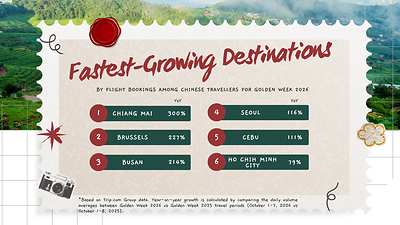
Millennials and Gen Zs are leading this trend, with those aged 18 to 24 showing the highest YoY growth in bookings across age groups. Known for its natural landscapes, New Zealand is an emerging destination among Gen Z travellers, with Queenstown and Auckland capturing a YoY rise in flight bookings of 314% and 276% respectively. Secondary cities, including Incheon and Chiang Mai, are also growing rapidly in popularity among this age group[2].
Inbound Tourism Growth as Asia Celebrates Mid-Autumn
With the Mid-Autumn Festival widely celebrated across Asia, and China's growing appeal among international travellers, inbound tourism is showing strong signs of growth.
Lesser-known Chinese cities such as Yanji, Dunhuang and Hailar are experiencing some of the fastest increases in flight bookings, while major cities like Shanghai, Beijing and Guangzhou continue to attract strong inbound travel flows, popular with visitors from Hong Kong SAR, South Korea, Singapore, Malaysia, as well as Australia.
With its rich cultural heritage and myriad attractions, China is fast becoming a popular holiday destination across all ages. One of the top-booked attractions among overseas visitors this Golden Week is the Mutianyu Great Wall, which travellers can experience via Trip.com's free layover tour, Beijing Express. Launched in December 2024, the tour offers international travellers with over 8 hours of layover time to explore Beijing's top attractions, including Mutianyu Great Wall, Temple of Heaven and Tiananmen Square. Based on Trip.com's Express Tours latest data, Mutianyu Great Wall route accounts for more than half of all Beijing Express bookings, and is the most popular choice among overseas visitors during the extended Golden Week holidays. Other popular attractions include the Shanghai Disney Resort, Emperor Qinshihuang's Mausoleum Site Museum and Zhangjiajie National Forest Park, all ranked on Trip.Best's 2026 global list of recommendations on 'Best Things to Do'[3].

Long Holidays Drive Intra-Asia Travel
Globally, Seoul ranks as the top holiday destination during Golden Week this year, with 91% YoY growth in international flight bookings. Beyond the bustling capital, global flight bookings to Busan, Cheongju and Daegu are also showing three-digit YoY growth, revealing South Korea's multifaceted appeal as a travel destination. Meanwhile, Japan remains a popular destination for many Asian travellers, including those from Malaysia, Thailand and South Korea[4].

This year's Mid-Autumn Festival also coincides with one of the most important holidays in South Korea, Chuseok, fuelling further travel exchanges within the region. Similar to Chinese tourists, South Korean travellers can extend their Chuseok holiday by taking three days off (September 19-27), and Trip.com Group's data shows that this is driving travel growth, with flight bookings to Fukuoka and Shanghai seeing YoY increases of 70% and 68% respectively. Japanese and Chinese travellers are the primary drivers of this travel growth, highlighting strong exchanges in demand within the region[5].
Together, these patterns reflect robust travel growth across Asia, boosted by long and overlapping holidays.
About Trip.com Group
Trip.com Group is a global travel service provider comprising of Trip.com, Ctrip, Skyscanner, and Qunar. Across its platforms, Trip.com Group helps travellers around the world make informed and cost-effective bookings for travel products and services and enables partners to connect their offerings with users through the aggregation of travel-related content and resources, and an advanced transaction platform consisting of apps, websites and 24/7 customer service centres. Founded in 1999 and listed on NASDAQ in 2003 and HKEX in 2021, Trip.com Group is on the mission "to pursue the perfect trip for a better world". Find out more about Trip.com Group here: group.trip.com.
Follow us on: X, Facebook, LinkedIn, and YouTube.
[1] Based on Trip.com Group data from September 25 - October 7, 2026. Year-on-year growth is calculated by comparing the daily volume averages between the extended Golden Week 2026 travel period (September 25 - October 7, 2026) and Golden Week 2025 travel period (October 1-8, 2025). |
[2] Based on Trip.com Group data from October 1-7, 2026. Year-on-year growth is calculated by comparing the daily volume averages between the core Golden Week 2026 travel period (October 1-7, 2026) and Golden Week 2025 travel period (October 1-8, 2025). |
[3] Based on Trip.com data from September 25 - October 7, 2026. |
[4] Based on Trip.com Group data from October 1-7, 2026. Year-on-year growth is calculated by comparing the daily volume averages between the core Golden Week 2026 travel period (October 1-7, 2026) and Golden Week 2025 travel period (October 1-8, 2025). |
[5] Based on Trip.com data from September 19-27, 2026. Year-on-year growth is calculated by comparing the daily volume averages between the extended Chuseok 2026 travel period (September 19-27, 2026) and Chuseok 2025 travel period (October 3-9, 2025). |

 View original content to download multimedia:https://www.prnewswire.co.uk/news-releases/golden-week-2026-fuels-extended-breaks-and-new-travel-routes-tripcom-group-reveals-rising-destinations-and-regional-trends-302883152.html

Die Exzellenzstrategie von Bund und Ländern stellt die Weichen für die nächste Förderperiode – und verschiebt die Gewichte im deutschen Wissenschaftssystem. Zu den bundesweit fünf neuen Exzellenzstandorten gehören die Technische Universität Darmstadt, die Goethe-Universität Frankfurt und die Johannes Gutenberg-Universität Mainz, die sich als Allianz der Rhein-Main-Universitäten (RMU) durchgesetzt haben. Ebenfalls erfolgreich waren in Nordrhein-Westfalen die Universität zu Köln sowie der Verbund Ruhr Innovation Lab aus TU Dortmund und Ruhr-Universität Bochum.
Für Hessen ist die Entscheidung ein Durchbruch: Erstmals tragen Universitäten des Landes ab 2027 den Titel „Exzellenzuniversität“. Die RMU-Allianz erhält nach Angaben des hessischen Wissenschaftsministeriums über sieben Jahre eine Förderung von insgesamt bis zu 155 Millionen Euro, finanziert zu 75 Prozent vom Bund. Wissenschaftsminister Timon Gremmels spricht von den ersten Exzellenzunis in Hessen und zugleich vom ersten länderübergreifenden Verbund in der Exzellenzstrategie. Ministerpräsident Boris Rhein bezeichnet den Titel als Meilenstein für die Forschungslandschaft des Landes. Ein mittelhessischer Verbund aus den Universitäten Gießen und Marburg blieb im Wettbewerb dagegen ohne Erfolg.
Auch Nordrhein-Westfalen stärkt seine Rolle als Hochburg der Spitzenforschung. Neben der Universität Köln, die den begehrten Status nach einer früheren Förderphase von 2012 bis 2019 zurückerhält, steigt der Verbund aus TU Dortmund und Ruhr-Uni Bochum als Ruhr Innovation Lab in den Kreis der Exzellenzuniversitäten auf. Nach Angaben des Düsseldorfer Wissenschaftsministeriums baut das Land damit seine Führungsposition aus. Die Universität Bonn und die RWTH Aachen hatten ihren Exzellenzstatus bereits im Frühjahr verteidigt, sodass NRW künftig mit vier Standorten vertreten ist. Ministerpräsident Hendrik Wüst wertet dies insbesondere als Signal für die internationale Sichtbarkeit des Ruhrgebiets als Wissenschafts- und Innovationsstandort.
In Bonn gaben Bundesforschungsministerin Dorothee Bär und der niedersächsische Wissenschaftsminister Falko Mohrs als Vize-Vorsitzender der Gemeinsamen Wissenschaftskonferenz (GWK) neben den Standorten in Hessen und NRW auch die Universitäten Freiburg und Jena als neue Exzellenzunis bekannt. Für Einzeluniversitäten sieht das Programm Fördermittel von bis zu 15 Millionen Euro pro Jahr vor, bei Verbünden wie der Rhein-Main-Allianz oder dem Ruhr Innovation Lab können es bis zu 28 Millionen Euro sein. Damit wächst die Riege der Exzellenzuniversitäten, deren bisher neun Standorte – darunter Aachen, Bonn, Dresden, Hamburg, Heidelberg, Karlsruhe, München, Tübingen sowie die Berlin University Alliance – ihre Förderung bereits im Frühjahr um weitere sieben Jahre verlängert hatten. Der Titel ist jeweils an regelmäßige Überprüfungen der Fördervoraussetzungen geknüpft.


